So, though it really doesn't have much to do with the purpose of this blog, and probably isn't that interesting for the intended audience of this blog, I thought it would be interesting (or at least nostalgic) to list every SLR camera I've owned since I was a teenager.

Imagery-wise, I have a few nice studio shots that I've taken of a few of the cameras, especially the ones that I own now. For most of the cameras, however, the images I have are those I took when I was preparing to sell them on eBay. Amazingly, I actually have photos of every SLR I've ever owned.
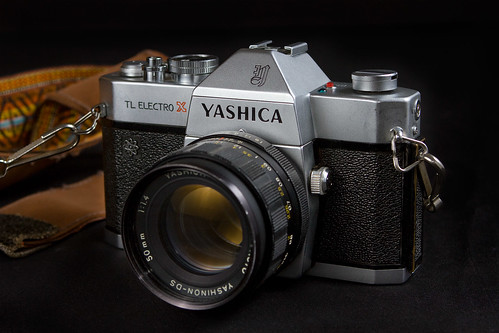
Yashica TL Electro X (1973-1979)
I've already done a blog post on my first camera, a Yashica TL Electro X, so I won't say much more about it except that this is the one camera I still have after all these years. Most of the others were sold to fund the purchase of the next camera. I bought this camera in 1973 and gave it to my father around 1979 or 1980. He used it for many years before returning it to me a couple of years ago.
In my early 20's I moved out to a commune, and departed the world of photography. Though I did many things in my career, I didn't take up photography seriously again until 1998, when I spent the summer living in Idyllwild, in the San Jacinto Mountains of southern California.
Minolta Maxxum 500si (1998-2002)
I had just finished doing some lucrative utility company consulting, and had always been attracted to Idyllwild, so I rented a cabin and spent the summer hiking and goofing off. I was immediately taken by the stunning beauty of the area, and decided to buy a camera and start taking pictures.
I bought a copy of Popular Photography and turned to the ads in the back of the magazine and ordered a camera over the phone. Internet-based eCommerce wasn't exactly where it is today.
The camera I selected was the Minolta Maxxum 500si, mostly because it was the cheapest SLR that would allow me to do long exposures using a cable release. I wanted to do night photography, and the 500si was the cheapest thing that did what I wanted.

My Minolta Maxxum 500si (up for sale on eBay)
This was a decent little camera, but I quickly realized that it wasn't really ideal for the type of landscape photography work I wanted to do. I needed to use manual exposure mode a lot, and it was not ideally set up to give that level of control to the photographer.
Still, this camera went with me to the top of San Jacinto Peak, to Yosemite Valley and Hetch Hetchy, and all over the Sierra Nevada. I got some wonderful images with this camera, and have to credit it for getting me into photography again. I've been taking photos steadily since I bought this camera.

Sunrise on El Capitan, Yosemite Valley (Minolta Maxxum 500si, Kodachrome 64)

Shooting Stars in the San Jacinto Mountains (Minolta Maxxum 500si, Kodak Royal Gold 200)

Sunrise in the Alabama Hills
(one of the last photos taken with my Maxxum 500si, Kodak Max 400)
(one of the last photos taken with my Maxxum 500si, Kodak Max 400)
Minolta Maxxum 7 (2002-2003)
Over Christmas break in 2001, I drove down to visit my parents in San Diego. I went down the east side of the Sierra Nevada with the intent of spending a few days photographing the east side on my way.
I distinctly remember setting up to do some sunrise exposures in the Alabama Hills (see above image) and being fed up with the limitations of the Maxxum 500si. I resolved there and then that I would buy a new camera for myself when I got to San Diego.
I went to a camera store in downtown San Diego (probably the same place I bought my old Xashica) and bought a Minolta Maxxum 7. I think it cost me about $550, which seems a laughably small amount given what high end digital cameras cost today.
This was without a doubt the most ergonomic camera I've ever owned. It was a real photographer's camera; flexible, easy to use, capable. Within about six months of purchasing this camera, I decided that I wanted to do photography professionally.

My Minolta Maxxum 7 (up for sale on eBay)

My Minolta Maxxum 7 kit, including Tamron 24-135mm Macro Zoom, Minolta AF 100-300mm Zoom, Tokina 20-35mm Zoom (which was killer sharp)
I also took some of my favorite photos of all time with this camera, even though I only owned it for a year. No camera since has felt as much a part of me as did this camera. Minolta never got the credit it deserved for such a great 35mm SLR camera.

Sutter Buttes (Minolta Maxxum 7, Tokina 20-35mm lens, Fuji Velvia)

JW Ranch (Minolta Maxxum 7, Tamron 28-200mm lens, Fuji Velvia)

Sunset and Bare Oaks, New Years Day, 2003
(one of the last images taken with my Minolta Maxxum 7, Tamron 24-135mm lens, Fuji Velvia)
(one of the last images taken with my Minolta Maxxum 7, Tamron 24-135mm lens, Fuji Velvia)
Mamiya 645 Pro (2003-2005)
On New Years Day 2003 I was taking photos along La Porte Road near Bangor in Butte County, in the foothills at the eastern edge of the Sacramento Valley, when I ran into another photographer shooting with a 4x5 camera. We got to talking, and he convinced me that I'd never make it professionally shooting 35mm film. He felt that you needed to shoot large format (4x5) in order to be competitive. I didn't quite believe that, but he did convince me that, as much as I loved my Maxxum 7, that I needed to move to a larger format to be successful.
So I immediately went out and bought a Mamiya 645 Pro kit, including lenses, gadgets and whatnot on eBay. I think the whole kit cost me about $2500.


Now this was a REAL camera, and a completely different experience from the 35mm cameras I had owned. For one thing, it was huge and heavy. I really built up some arm muscles hauling that camera around It was also fully manual - no auto exposure modes, no auto focus, no auto anything. This really made me learn how to photograph. Though I shot mostly in manual exposure mode with the Maxxum 7, I had no choice here, and learned how to read and adjust exposures very well.
But this was a fantastic camera. Like the Minolta, it was a photographer's camera, though in a different way. Where the Minolta was designed to be easy to handle, the Mamiya was designed to be a precise tool, not an easy to use one. And as with the Minolta, I took some of my favorite photos of all time with this camera.
I actually held onto it for a number of years after I stopped shooting with it, just because I loved it so much.


In Part II, I'll talk about my switch to digital, as well as the explosion of camera buying that's happened in the past year!
So I immediately went out and bought a Mamiya 645 Pro kit, including lenses, gadgets and whatnot on eBay. I think the whole kit cost me about $2500.
Mamiya 645 Pro, with 55-110mm zoom lens

Mamiya 645 Kit, including 55-110mm zoom, 105-210mm zoom, 45mm lens, 80mm lens, and 500mm lens.
Now this was a REAL camera, and a completely different experience from the 35mm cameras I had owned. For one thing, it was huge and heavy. I really built up some arm muscles hauling that camera around It was also fully manual - no auto exposure modes, no auto focus, no auto anything. This really made me learn how to photograph. Though I shot mostly in manual exposure mode with the Maxxum 7, I had no choice here, and learned how to read and adjust exposures very well.
But this was a fantastic camera. Like the Minolta, it was a photographer's camera, though in a different way. Where the Minolta was designed to be easy to handle, the Mamiya was designed to be a precise tool, not an easy to use one. And as with the Minolta, I took some of my favorite photos of all time with this camera.
I actually held onto it for a number of years after I stopped shooting with it, just because I loved it so much.
Late Afternoon Oak (Mamiya 645 Pro, Mamiya 105-210 f/4.5 Zoom, Fuji Velvia 50)
Rice Field Panorama (Mamiya 645 Pro, Mamiya 55-110 f/4.5 Zoom, Fuji Velvia 50)
Aspens near Grant Lake (Mamiya 645 Pro, Mamiya 55-110 f/4.5 Zoom, Fuji Velvia 50)
In Part II, I'll talk about my switch to digital, as well as the explosion of camera buying that's happened in the past year!